Wednesday, 30 September 2009

RBS insist they've learned from their history

Today the Royal Bank of Scotland (RBS) submitted a document to the Scottish Parliament's inquiry into 2008's banking crash, insisting that the bank has accepted responsibility. Those executives believed to be responsible for the crash, of which RBS was at the epicentre in the UK, had left the business. Time will tell whether RBS truly have learned from their previous errors or whether similar mistakes will be repeated in future.

RBS would have done well to have heeded the past example of the City of Glasgow Bank, the ghost of which has stalked Scottish banking since its collapse and bankruptcy in 1878. Infact this collapse came just twenty one years after the collapse of the Western Bank of Scotland in 1857, from which the lessons had already supposedly been learned. In a time when Scotland's 'public' banks (those with Royal Charters), the Bank of Scotland and Royal Bank of Scotland had very conservative lending and deposit regulations, as well as very small branch networks, banks such as the City of Glasgow Bank attracted a great diversity of business and personal customers from the new middle classes. Many investors from the middle classes were also shareholders. What was unknown to most of these customers was that the bank's directors had fallen into the influence of a small group of Glasgow merchant houses which managed to borrow (a then) large sum of £5m between them with no likely repayment schedule. By comparison the deposit base was £8m; eventual net liabilities were shown to be £6m. Money had also been lost gambling on US railroad securities, and in gambling on mining stocks and in Australasian farming.

The bank was closed suddenly by the directors on the 2nd of October 1878; the doors of each branch were locked and there was no possibility of a Northern Rock style run. Rumours about the security of the bank had been circulating for some months on the London market, where confidence in the bank's bills had been falling. The closure of the bank rendered this paper useless, as well as making it impossible for depositors to reach their funds. At this time there were no government bailouts for banks, nor government deposit insurance. Depositors were eventually fully repaid from calls for payment made to the shareholders, who eventually faced calls of £2,675 against a £100 holding. At this time banks did not have limited liability as it was thought this would reduce public confidence in them; this meant the shareholders were liable for all of the bank's debts. Many of the shareholders themselves ended up being made bankrupt, although they were given shares in the Assets Company Ltd., which pooled many of the bank's remaining assets which were still of value, giving them some recompense in the longer run. And the directors? They didn't just lose their jobs - they were sent to prison.

Gordon Brown returns to old venture capital idea

Yesterday UK Prime Minister Gordon Brown gave his 'keynote' speech at the UK Labour Party Conference, setting out the party's policies for the 2010 General Election. There was precious little on business policy; the headlines were grabbed by the promise of new regulations to disqualify negligent bank directors if they are considered to be unfit to run banks. Quite how it is to be decided that they are unfit to run banks remains unclear, but the FSA as it stands may not be the best people to judge this. The other policy announced has been elaborated on even less - this is a promise to create a new £1bn 'national investment corporation' to provide finance for new and growing businesses.

This interested me because back in the days when bankers were to be trusted with the economy we did indeed have a similar body. The Bank of England created the Industrial and Commercial Finance Corporation (ICFC) in 1945 to plug the gap then extant in corporate finance for firms too small to obtain stock exchange or merchant bank capital. The Big 5 UK clearing banks also took stakes in ICFC, helping to provide capital to the infant firm. During this period ICFC was successful in providing finance for start-ups, although in a period of general industrial decline in the UK the benefits remained unclear. ICFC was renamed Finance for Industry in 1973, then became Investors in Industry, or 3i in 1983. The banks then floated on the stock exchange in 1987. Ironically 3i was later better known for its role in funding mature businesses such as National Car Parks and the German/Danish ferry operator Scandlines, than start-ups, particularly during the private equity boom of 2005-7.

It remains to be seen how Gordon Brown's proposed firm will work in the event that he wins the 2010 election, but it will be interesting to see where the capital for it comes from, how it will be constituted (hopefully he won't repeat the Alan Sugar mistake by putting the star's of TV's Dragon's Den in charge) and what schemes are considered worth investing in by the new body. And further, how long will it be before the new company, which if it invests well in rapidly growing firms, should become very valuable, ends up itself being floated off by a future government seeking a quick return? This would jeapardise the original purpose of the new company, just as the banks did with 3i.

Monday, 28 September 2009

Government not keen to scrap scheme

A brief follow-up from Thursday's post. Today Lord Mandelson announced the extension of the UK government's car scrappage scheme to include a further 100,000 vehicles above and beyond the scheme's original target of 300,000 vehicles. The scheme gives any motorist scrapping a car that is more than 10 years old £2,000 off a new car, half funded by government and half funded by the car manufacturer themselves. This move will extend the cost of the scheme to government to £400m, up from £227m. Mandelson argued that it was important to help the car industry through difficult times. While keeping businesses going and workers in jobs may be important in the short term, the long run benefits are unclear; arguably government subsidised the price of British Leyland cars through the 1970s, as well as buying its products for government use (such as post office vans) this did not help British Leyland sustain itself in the long term. And indeed at present the scrappage scheme is only increasing the proportion of UK production sold in the UK market rather than increasing total car sales, which in August this year were down 31.5% compared to August 2008. And this at a time when the pound is extremely weak which should help the competitiveness of UK exports. Like many other government interventions in industry, this one is just intended to make politicans look good rather than improve competitiveness and profitability in industry, which is what will keep the jobs in the UK in the long run.

Thursday, 24 September 2009

The car industry - still worthwhile in mature economies?

Today Jaguar Land Rover, the British sports and offroad car manufacturer (which is actually owned by the Indian company Tata) announced that it plans to close one of its three UK factories in the next ten years, to consolidate production onto one site. Meanwhile the UK's Business Secretary Lord Mandelson has claimed that the Canadian car parts firm Magna's plans for the Vauxhall and Opel divisions of General Motors, which it is purchasing, are not commercially viable. Mandelson's reasoning for this is unclear, except that it is claimed that 1,100 jobs will be lost in the long term.

Historically the car industry, as a second industrial revolution industry, has been at home in mature economies where it produced linkages with other parts of the second industrial revolution economy, backwards into the steel, tyre and electronics industries, and forwards into the distribution and retail sectors. Indeed David Landes suggested that these linkages made the car industry "the industry of industries", perhaps the most vital to a modern industrialised economy.

However, the position of the car industry in many western countries has been one of decline for many years; the decline of the US big 3, General Motors, Ford and Chrysler in recent years being one sign of this. In the UK the position has been similar, with the UK's motor industry gradually consolidating through the 1950s and 1960s, then being forced into the super-consortium British Leyland (BL) by the government in 1968. Government believed that the failing British Motor Holdings could be saved by merging it with the successful truck and bus manufacturer Leyland, thus preserving employment. BL was unable to carry out the necessary rationalisaton of ranges, and its competitive position faltered to the extent that the government nationalised it in 1975 to preserve employment in the industry, and that of related industries. The Thatcher government was able to slim down and privatise BL as Rover in 1986, but even this has passed through a number of (government supported) owners and gradually withered away.

Given this history of unsuccessful government intervention in the industry, and history of gradual decline, its all the more amazing that Mandelson still believes that the motor industry in the UK has a viable future. While its clear that there is still potential for the industry in the UK as cars are expensive to transport, they are becoming increasingly cheap to make as Asian manufacturers find new scale economies in car production, seeking to boost the mass market in their home countries. Jaguar Land Rover's owners Tata, for instance are already making a basic car with a price to the consumer of less than US$2,000. It seems unlikely that British manufacturers could match these sort of economies in the long term, which must eventually make importing worthwhile, for the volume market at least. Surely governments in developed countries would be better to allow car manufacturers to make the savings required to remain competitive rather than forcing them to produce cars that they won't be able to sell to consumers. Such a strategy will mean that the present state interventions won't be the last.

Wednesday, 23 September 2009

Regulation - escaping capture

Yesterday I talked about how regulation helped to shape the television industry in the UK. But what of industries that shape the regulator? Today two stories about regulation in the banking and finance industry caught my eye. Firstly the European Union unveiled its tentative plans for banking 'super-regulators', intended to form a supra-national banking authority capable of intervening in the regulatory affairs of member states. Its hoped that this structure, which would create a European Systemic Risk Board to monitor levels of future risk, as well as watchdogs specific to the banking, insurance and stock exchange sectors. It remains unclear what will be considered a bad risk or bad banking, insurance or stock exchange practice, but the proposal may well be a good one, especially as it appreciates the need for an international approach to what is today a very international industry.

Meanwhile back in the UK Lord Turner, Chairman of the UK regulator, the Financial Services Authority (FSA), argued last night that 'radical change' was required in the UK financial sector, in which banks must focus on their 'essential social and economic functions'. This is code for going back to the boring old days of the clearing banks which effectively operated as the cogs for the system, with merchant and private banks as well as building societies indulging in most of the risky stuff. Whether this should happen or not is another post, but first we should decide what we want our banks to do. Then to encourage them to do this we will have to remove people with banking or financial interests from the regulatory sector to prevent 'regulatory capture', in which poacher turns gamekeeper. Industries tend to be rather close knit, with management personnel frequently moving from firm to firm and knowing those at other firms well; they may even have attended the same universities or even schools. The potential, then for a banker who is hired as a regulator, no matter how well paid, to view his friends in a neutral way seems low, further they may even emphasize with practices considered fashionable in the banking industry but which are perhaps not in the public interest. If we are to create a European regulatory organization, the worst starting place would surely be to staff it with former bankers. Regulators need to be recruited from other areas - well informed, but with a different background and different interests to those they regulate.

By way of exemplifying the UK situation - the present CEO of the FSA, Hector Sants, has an impressive CV including having worked for Credit Suisse First Boston, as well has previously having been a director of the London Stock Exchange. Deputy Chair Hugh Stevenson is presently Chairman of Equitas Limited, an re-insurance company, and The Merchant's Trust Plc., an investment trust, and has numerous past positions in the finance industry. Sants and Stevenson would no doubt argue that their experience in the financial industry puts them in an excellent position to oversee good practice in the industry. But as Sants and Stevenson have both had senior positions at the FSA since 2004, well before the present crisis, does the reality of their tenure suggest that they have done this?

Tuesday, 22 September 2009

British Television - an industry shaped by technological and regulatory constraints

The decline of the mainstream commercial television industry in Britain continues apace as the industry struggles to compete with the internet and the entry of digital and satellite channels, as well as the general diversification of entertainment. Today saw two separate news stories regarding the continued troubles of ITV plc., the UK's largest terrestrial broadcaster. This morning a story appeared warning that ITV, (which runs the UK's 'Channel 3' in England and Wales) as well as Scottish and Northern Irish franchisees STV and UTV could sink into deficit on their license payments to government by 2012 by £38-£64m. This would come on top of already substantial losses which are unlikely to be stemmed fully by 2012; ITV made a deficit of £2.7bn in its 2008 operating year. Additionally ITV and STV are at loggerheads as STV has dropped many of ITV's programmes from its schedules to save money, and today ITV, stung by the loss of a major client for its output launched a claim for £38m it claims it is still due from STV. Scottish viewers meanwhile find themselves unable to watch ITV's core entertainment schedule.

Many of these problems arise because of a historical straitjacket that ITV, STV and UTV find themselves in. Back in the 1950s when central government decided to introduce commercial television into the UK to compete with the public service BBC the amount of bandwidth available was constrained by VHF transmission technology then in use. Additionally the General Post Office, the government ministry which at that time ultimately controlled communications, was unwilling to license more than one commercial channel. However the 1954 Television Act required that 'adequate competition' exist between programme suppliers. A system of 15 or so local monopolies was thus devised which would sell each other programmes, as well as provide regional news and programmes for their region. More populous regions, such as London, the Midlands and North were given two programme companies, one of which would broadcast during the week, the other at weekends. These larger companies were also to be responsible for supplying companies in more marginal regions, such as North East England or the West Country with programmes. This contrasts with the system of affiliates which evolved in the USA or Australia for example, where a central company supplies programmes to a network of affiliates which produce nothing but local news. In practice there was little competition between programme companies, with a fairly standard schedule evolving across all regions. But the system worked, and the companies made money.

Coming back towards the present, the main competition introduced by the 1990s was from the state owned but commercially funded Channel 4 and from the satellite company BSkyB. ITV remained the only fully commercial terrestrial network in the UK, a position it effectively still holds, Channel 5 having been introduced in 1997 when the industry was already in decline. A system of premium payments for ITV license holders was introduced in the 1990 Broadcasting Act, which was also accompanied by a de-regulation allowing companies to own more than one franchise. The result was that many of the smaller companies were gradually swallowed up by the larger companies until the eventual formation of ITV plc in 2004, a consolidation of about 12 companies in as many years. The result has been a gradual rationalisation of content production, with local news areas merged together and the channel relying on a smaller portfolio of hit shows. The remaining TV audiences have left ITV for the BBC and newer operators, while it seems likely that the company's news production, which has gradually lost gravitas, will be bailed out by the 'top slicing' of the TV license fee, at one time unthinkable.

Had the UK adopted a system similar to that of the US, of competing networks based around a single supplier, in the 1950s we might now have a more healthy broadcasting industry. Such a system would have achieved the centralisation that ITV's management wanted to attain in the 1990s while providing the competitive incentive to keep standards high. Affiliated stations also compete for local news audiences in the US and such a system could have kept standards up in the UK, maintaining audiences for local news on television. Additionally a dispute such as the present STV/ITV could be solved by ITV finding an alternative outlet for its programmes in Scotland. Its even likely that the challenge of Sky in areas such as sport broadcasting could have been headed off more effectively with a wider range of bidders for sport in the first instance. The quality of news on commercial television generally would also be higher as channels competed with each other, rather than playing second fiddle to the BBC as ITV has. Unfortunately none of this was foreseen in 1954, and the opportunities for reform were not taken later, for instance when the first UHF channel was given to the BBC. Which is why today the BBC continues to dominate UK broadcasting with the commercial sector, much stronger in most countries, left far behind.

Monday, 21 September 2009

Oil has always been a cyclical industry

Oil, always controversial but necessary for everyday life in the 21st century, hit the news in two separate ways today. First came the news that oil prices have fallen again due to signs that demand is not recovering due to the recession, and that it was unlikely that recovery in prices would come until we see a sustained economic recovery across the world. Secondly, the CEO of French oil company Total warned that when recovery comes we may see a shortage of oil as a result of cutbacks in exploration caused by the recession.

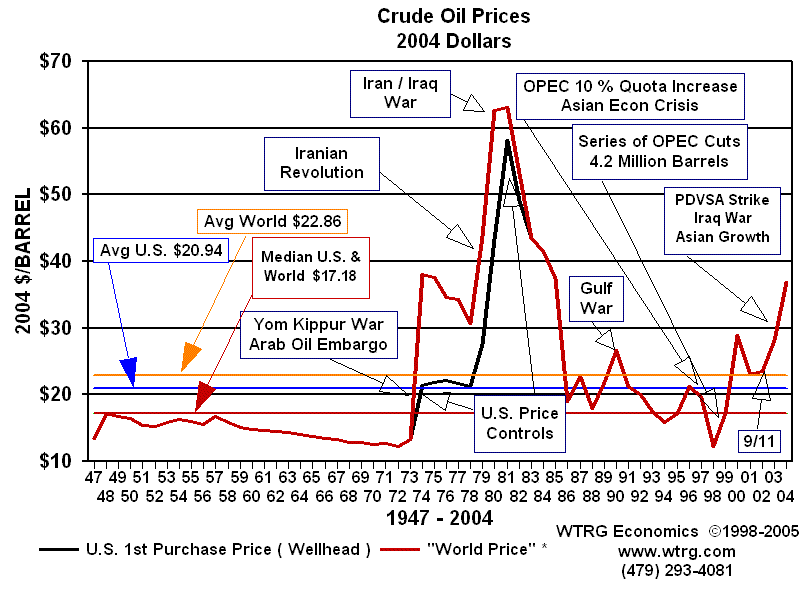
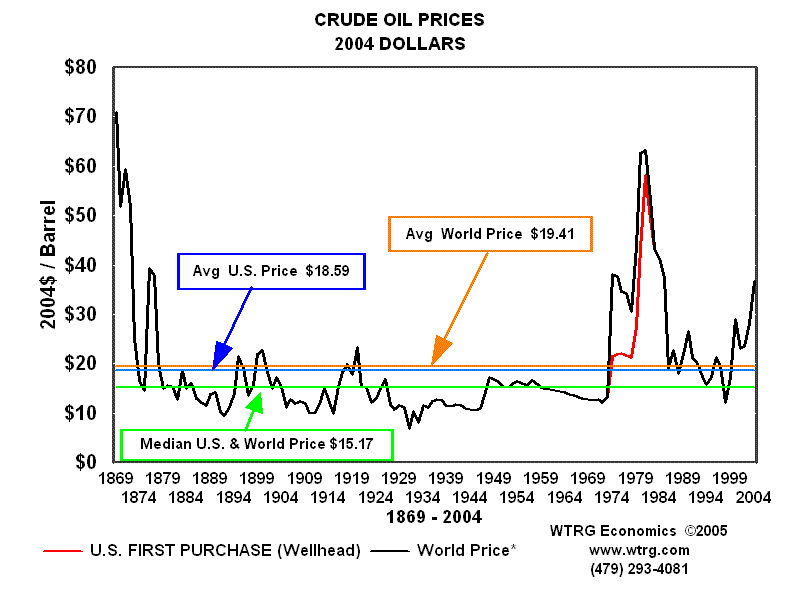
While M. de Margerie is quite correct, he is of course displaying the sort of foresight about the economic cycle that only seems to be displayed in recession, i.e. that good times are around the corner (the bad times that follow booms are rarely publicly predicted by CEOs for obvious reasons). However, its unclear that we should worry about this issue unduly because oil is of course a commodity industry (one where the product produced is homogeneous with little scope for differentiation). As the graphs on WTRG Economics' site indicate oil has a long history of fluctuation related to supply, and the effect of political events upon supply. Conversely periods of prosperity and relative political calm, such as the late 1950s and early 1960s have tended to see production gradually opened up with prices falling away. If we look in the long term we see that prices between the original establishment of the industry in the 1870s and the First Oil Crisis of 1973-4 had always bobbed up and down through supply and demand cycles, albeit by a far lesser degree than post 1973. If we predict however that the next spike is likely to be around $100 then we can predict that as we begin to climb to that spike then exploration will be opened up, with some fields ready to be brought on stream shortly after that spike. Needless to say, it seems likely that Total can gain a lot from the likely 'shortage' to come.

Followers

About Me

London, United Kingdom
I'm Lecturer in Management at The York Management School, at The University of York, UK. I teach strategic management to undergraduate and masters students, as well as running the masters dissertation module. My research focuses on business and management history.